Are you tired of the spinning wheel of doom? The agonizingly slow loads that interrupt your flow, the dropped video calls that shatter your professionalism, and the dead zones that leave entire rooms of your home frustratingly offline? You're not alone. In today's hyper-connected world, a weak Wi-Fi signal isn't just an inconvenience; it's a roadblock to productivity, entertainment, and even basic communication. We rely on our wireless networks for almost everything, from streaming our favorite shows to managing our smart homes and working remotely. A staggering 73% of remote workers report slow internet speeds reduce their productivity by at least 20%, underscoring the tangible impact of poor connectivity. The frustration is real, a constant digital gnawing that erodes our patience and our ability to get things done. But what if you could reclaim that strong, reliable Wi-Fi signal? What if you could transform your patchy, unreliable network into a robust, high-performance powerhouse? This isn't just about fixing a technical glitch; it's about unlocking seamless connectivity that empowers your digital life. This ultimate troubleshooting guide is your roadmap to understanding, diagnosing, and conquering those frustrating Wi-Fi woes. We're going to dive deep, exploring every facet of your wireless network, from the simplest environmental tweaks to more advanced configurations, so you can finally enjoy the blazing-fast, uninterrupted Wi-Fi you deserve.
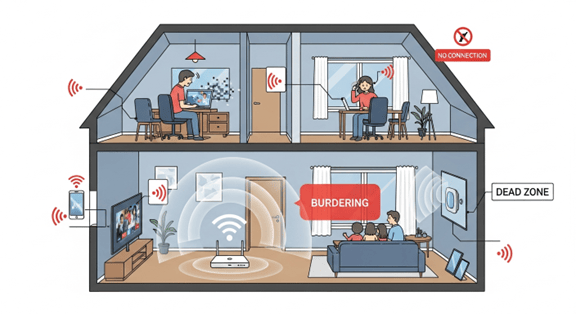
Why a weak Wi-Fi signal is a problem
A weak Wi-Fi signal can create digital 'dead zones' and performance bottlenecks, impacting everything from remote work to entertainment and smart home devices.
A weak Wi-Fi signal is far more than just a minor annoyance; it's a pervasive issue that can cripple your digital experience. Imagine trying to conduct an important video conference only to be met with constant freezing and robotic audio – a scenario that can severely damage professional credibility. For families, it means the agonizing wait for children's educational videos to buffer or the disappointment of a movie night disrupted by a dropped connection. The average number of connected devices per US internet household has reached 17, meaning more devices are vying for a piece of your network's bandwidth, often leading to performance bottlenecks if not managed effectively. These weak spots, often called dead zones, can turn entire rooms or areas of your home into digital deserts, rendering your smart devices useless and your Wi-Fi connection practically non-existent. This pervasive unreliability can lead to a host of frustrating symptoms: slow download and upload speeds, frequent disconnections, and the dreaded buffering that plague streaming services. Beyond convenience, a compromised Wi-Fi network can also present security risks, making your personal data vulnerable if the network isn't robust and properly secured.
How this guide will help you
This guide is designed to empower you with the knowledge and actionable steps needed to diagnose and fix your weak Wi-Fi signal, transforming your connectivity from a source of frustration into a reliable asset. We'll cut through the jargon and provide a clear, step-by-step approach, starting with understanding the root cause of your signal issues and progressing through practical solutions. You'll learn how to pinpoint the exact areas where your Wi-Fi struggles, understand the invisible forces of interference that plague your wireless network, and discover how to optimize your existing equipment before even considering new purchases. For those whose issues persist, we'll delve into hardware upgrades, discussing the nuances of Wi-Fi extenders, mesh Wi-Fi networks, and the latest Wi-Fi standards. Furthermore, we'll equip you with the knowledge to fine-tune your router's settings for peak performance, manage your bandwidth effectively, and even understand how your Internet Service Provider (ISP) and Modemplay a role. By the end of this guide, you won't just have a stronger Wi-Fi signal; you'll have a deeper understanding of your network's intricacies and the confidence to maintain its optimal health and security.
Step 1: Diagnosing your Wi-Fi woes (where is the weakness?)
Before we can fix anything, we need to understand precisely what's broken. Many users intuitively know their Wi-Fi is weak, but a truly effective solution begins with identifying the scope and nature of the problem. Is it a complete dead zone in the back bedroom, or are all your devices experiencing sluggish performance no matter where they are? Are certain connected devicesperforming worse than others? Pinpointing the exact symptoms and their locations is crucial for a targeted and successful troubleshooting approach. Without this diagnostic phase, you risk wasting time and money on solutions that don't address the real issue. This step is about becoming a detective for your home network, gathering clues to understand the full picture of your Wi-Fi's shortcomings.
Identify the symptoms and scope
The first step in diagnosing your weak Wi-Fi signal is to meticulously identify the symptoms you're experiencing and understand the scope of the problem. Are you noticing slow internet speeds across all your devices, or is it specific to certain connected devices? Do you experience frequent disconnections, leading to dropped calls or interrupted streaming buffering? Perhaps you've noticed entire areas of your home where your Wi-Fi signalsimply doesn't reach, creating frustrating dead zones. A significant portion of users, 36% of Americans, admit they don't even know their internet speed, highlighting a common knowledge gap that makes objective assessment difficult. Take stock of where and when these issues occur. Is it worse in the evening when more devices are online? Does it happen near specific appliances? Are older devices struggling more than newer ones? Documenting these observations will provide invaluable insights into the underlying causes of your weak Wi-Fi.
Test your Wi-Fi performance objectively
To move beyond subjective frustration and into concrete problem-solving, it's essential to test your Wi-Fi performance objectively. This involves using tools to measure the actual speed and strength of your connection. Our free speed test tool is a great place to start. Numerous free online speed test websites and apps are also available, such as SpeedGEO.net. Run these tests in various locations throughout your home, especially in areas where you experience the weakest signal. Compare the results to the internet speed you're paying for from your Internet Service Provider (ISP). If your speeds are consistently lower than advertised, especially when you're close to your router, the issue might lie with your ISP's service or your Modem. However, if speeds are acceptable near the router but degrade significantly as you move away, it strongly indicates a Wi-Fi coverage problem rather than an internet service issue. This objective data is critical for understanding whether your Wi-Fi network is performing as it should, forming the foundation for targeted troubleshooting.
Pinpoint Wi-Fi weak spots
Once you have objective speed test data, the next logical step is to meticulously map out your Wi-Fi dead zones and weak spots. While speed tests give you numbers, visually identifying these areas is crucial for effective improvement. You can do this manually by walking through your home with a Wi-Fi analyzer app on your smartphone. These apps display the Wi-Fi signal strength in decibels (dBm) – a lower (more negative) number indicates a weaker signal (e.g., -70 dBm is weaker than -50 dBm). Alternatively, many routers have companion apps that offer Wi-Fi heatmaps, visually showing signal strength across your floor plan. The goal is to identify specific rooms, corners, or even floors where the signal consistently drops below an acceptable threshold for your needs. This targeted approach helps you understand the extent of the coverage issue and where improvements are most needed, informing decisions about router placement, the use of Wi-Fi extenders, or mesh Wi-Fi networks.
Step 2: Optimizing your router's environment (the foundation of a strong signal)
Often, the most significant improvements to your Wi-Fi signal can be achieved without spending a dime on new hardware. Your router is the heart of your wireless network, and its environment plays a monumental role in its ability to broadcast a strong and consistent signal. Think of it like placing a radio – you wouldn't bury it in a closet or surround it with metal. The same principles apply to your router. Proper placement and minimizing obstructions are the first lines of defense against a weak Wi-Fi signal. This foundational step addresses the physical realities of signal propagation and is often overlooked in the rush to configure advanced settings or buy new gadgets. Getting this right sets the stage for all subsequent troubleshooting efforts.
Ideal router placement for maximum signal coverage
Achieving optimal Wi-Fi signal coverage starts with intelligent router placement. The general rule of thumb is to position your router in a central location within your home, as close to the areas where you use Wi-Fi the most as possible. Elevating the router, placing it on a shelf or mounting it on a wall, can also improve its broadcast range. This is because Wi-Fi signals tend to broadcast downwards and outwards, so an elevated position allows for better distribution. WiFi performance heavily depends on router placement, with central, open, and elevated positions delivering stronger, more consistent coverage. Avoid tucking your router away in a cabinet, basement corner, or behind large furniture. These enclosed spaces act like a shield, significantly weakening the signal before it even has a chance to travel. Remember, the goal is to give the signal the clearest path to reach all corners of your home.
Avoid common physical obstacles and interference sources
Beyond just placement, it's critical to be mindful of the physical obstacles and common interference sources that can degrade your Wi-Fi signal. Thick walls, especially those made of brick, concrete, or plaster with metal lath, can significantly attenuate the signal. Metal objects, such as filing cabinets, large appliances, and even mirrors, can reflect and block Wi-Fi signals. Even certain aquariums can create dampening effects due to the water. Beyond physical barriers, numerous household electronics emit radio frequencies that can interfere with your Wi-Fi. Microwaves, cordless phones (especially older 2.4GHz models), Bluetooth devices, and even some baby monitors can broadcast on similar frequencies to your Wi-Fi, causing disruptive interference. Interference in Wi-Fi refers to the disruption or degradation of wireless signals due to various external factors, including multiple devices operating on the same frequency, physical obstacles, or other electronic devices emitting overlapping signals. By identifying and moving your router away from these potential culprits, you can drastically improve signal clarity and strength.
Step 3: Taming interference (the invisible enemy)
Even with perfect router placement, your Wi-Fi signal can be sabotaged by invisible forces. Interference is a pervasive challenge in modern homes, where a multitude of wireless devices and neighboring networks compete for precious airwaves. Understanding how your Wi-Fi operates on different frequencies and channels is key to combating this digital congestion. This section delves into the science behind Wi-Fi interference and provides practical strategies to mitigate its impact, helping you reclaim a cleaner, more robust networkconnection. This isn't just about avoiding a microwave; it's about intelligently managing the invisible spectrum your Wi-Fi inhabits.
Understanding Wi-Fi channels and frequencies
Your Wi-Fi network operates on specific radio frequencies, primarily the 2.4GHz and 5GHz bands. The 2.4GHz band offers a wider range and better penetration through walls but is more prone to interference and offers lower speeds. The 5GHz band provides significantly faster speeds and less interference but has a shorter range and struggles more with physical obstructions. Within these bands, Wi-Fi uses multiple channels– think of them as lanes on a highway. If too many networks are using the same channel, it leads to congestion, slowing down everyone's performance. For example, the 2.4GHz band has 11 (in North America) or 13 (in Europe) channels, but only channels 1, 6, and 11 are truly non-overlapping. This overlap is a major source of interference from neighboring Wi-Fi networks. Understanding these concepts is the first step to intelligently selecting the best Wi-Fi channel for your network.
Changing your Wi-Fi channel for less congestion
One of the most effective ways to combat interference from neighboring Wi-Fi networks is to change your router's Wi-Fi channel. Most routers are set to "auto," meaning they choose a channel themselves, but this often results in them selecting a congested one, especially in densely populated areas like apartment buildings. You can manually select a less crowded channel. To do this, you'll typically log into your router's web interface (usually by typing its IP address, like 192.168.1.1 or 192.168.0.1, into a web browser). Navigate to the wireless settings, and you'll find the option to change the Wi-Fi channel. Using a Wi-Fi analyzer app on your smartphone or computer can help you identify which channels are most congested in your area. Prioritize channels 1, 6, or 11 for the 2.4GHz band. For the 5GHz band, there are more non-overlapping channels, but the principle remains the same: select one that is least utilized by your neighbors to minimize interference and improve your network performance.
Leveraging dual-band routers and band steering
Modern routers are typically dual-band, meaning they broadcast on both the 2.4GHz and 5GHz frequencies simultaneously. This dual-band capability is a powerful tool for managing interference and optimizing performance. However, simply having dual bands isn't enough; you need to leverage them effectively. Some routers offer a feature called "band steering," which intelligently pushes compatible connected devicesto the less congested and faster 5GHz band, while older or less capable devices remain on the 2.4GHz band. If your router doesn't have automatic band steering, you can often manually assign different SSIDs (network names) to each band (e.g., "MyHomeWiFi_2.4GHz" and "MyHomeWiFi_5GHz"). This allows you to manually connect devices to the appropriate band. For devices that support 5GHz and are located closer to the router, connecting to the 5GHz network can drastically reduce interference and improve speeds, minimizing buffering and enhancing overall Wi-Fi signal strength where it matters most.
Mitigating non-Wi-Fi interference sources
While competing Wi-Fi networks are a major source of interference, your home is also filled with other devices that can disrupt your Wi-Fi signal. As mentioned earlier, older cordless phones, microwaves, Bluetooth devices, and even some baby monitors often operate in the 2.4GHz frequency range, directly clashing with your Wi-Fi. The key to mitigating this type of interference is proximity and channel separation. If possible, move your routeraway from these devices. If moving the router isn't feasible, consider repositioning the interfering device. For example, if your microwave is causing intermittent Wi-Fi drops, try to avoid using it while engaged in critical online activities like video conferencing or gaming. Similarly, if you have older 2.4GHz cordless phones, consider upgrading to newer models that operate on different frequencies or using wired phones when network performance is critical. By being aware of these common household offenders, you can proactively create a cleaner Wi-Fi channel for your devices.
Step 4: Enhancing your Wi-Fi hardware (when basic fixes aren't enough)
If you've optimized your router's environment and tamed interference but are still experiencing weak Wi-Fi, it's likely time to consider upgrading your hardware. Your router is the linchpin of your wireless network, and older models may simply not be equipped to handle the demands of modern internet usage. Similarly, your devices' own network capabilities can be a bottleneck. This step explores the hardware solutions that can extend your Wi-Fi signal, boost performance, and future-proof your network. Consumer willingness to invest in solutions for better Wi-Fi is high, with 56% of consumers open to buying additional equipment if given clear recommendations.
Upgrade your Wi-Fi router
The router is arguably the most critical piece of hardware for your home Wi-Fi network. If your router is several years old, it might be using outdated Wi-Fi standards that are significantly slower and less efficient than current ones. Newer standards like Wi-Fi 6 (802.11ax) and Wi-Fi 6E offer substantial improvements in speed, capacity, and efficiency, especially in environments with many connected devices. Studies show that two-thirds of Wi-Fi shipments in 2023 will be Wi-Fi 6 or Wi-Fi 6E, indicating their growing prevalence and the benefit of upgrading. A modern router can better handle multiple devices, improve performance for demanding applications like 4K streaming and online gaming, and provide a stronger, more stable Wi-Fi signal. When choosing a new router, consider your internet speed plan, the size of your home, and the number of devices you need to connect.
Extending your Wi-Fi range (with nuance)
For homes with persistent dead zones or larger footprints, extending your Wi-Fi range is often necessary. The two primary solutions are Wi-Fi Extenders (also known as repeaters or boosters) and mesh Wi-Fi networks. A Wi-Fi Extenderworks by picking up your existing Wi-Fi signal and rebroadcasting it. While they can be an affordable option, they often come with a significant drawback: they can halve your bandwidth because they're simultaneously communicating with the router and your devices. For this reason, Wi-Fi Extenders are best placed halfway between your router and the dead zone, and are most effective for less demanding tasks. Mesh Wi-Fi systems, on the other hand, consist of a main router and one or more satellite nodes that work together to create a single, seamless Wi-Fi network with consistent coverage throughout your home. The global Mesh Wi-Fi Router Market is experiencing significant growth, reflecting their effectiveness in providing whole-home coverage. Mesh systems are generally more expensive but offer superior performance and a more seamless user experience, eliminating dead zones without the bandwidth penalty of traditional extenders.
Optimize or replace your device's network adapter
While much attention is given to the router, the network adapters in your connected devices– laptops, smartphones, tablets, and smart home gadgets – also play a crucial role in your Wi-Fi performance. An older device with an outdated wireless card might not be able to take full advantage of your modern router's capabilities, limiting its Wi-Fi signalreception and speed. For laptops and desktops, network adapter drivers can often be updated through your operating system or the manufacturer's website. Ensuring these drivers are current is a simple yet often overlooked step. In some cases, especially with older desktop computers, the internal Wi-Fi adapter might be a bottleneck. Replacing it with a newer USB Wi-Fi adapter that supports the latest Wi-Fi standardscan provide a significant boost. For smartphones and tablets, while you can't typically upgrade the internal hardware, ensuring your device's operating system is up-to-date can sometimes improve Wi-Fi performance.
Step 5: Fine-tuning your network settings (advanced configuration)
Once you've addressed the physical environment and hardware, delving into your router's settings can unlock even more performance gains and stability for your Wi-Fi network. These advanced configurations allow you to optimize how your router manages traffic, prioritizes data, and interacts with your connected devices. While these steps require a bit more technical comfort, the rewards in terms of a smoother, more responsive Wi-Fi signal can be substantial. This is where you move from basic troubleshooting to advanced network stewardship, ensuring your network is working as hard and efficiently as possible.
Update router firmware
Keeping your router's firmware up-to-date is a critical yet frequently neglected aspect of network maintenance. Firmware is the software that controls your router's operations, and updates often include performance enhancements, bug fixes, and, crucially, security patches. Outdated firmware can lead to a variety of issues, including reduced performance, instability, and vulnerability to cyber threats. Routers account for a significant share of discovered vulnerabilities in smart home devices, underscoring the importance of keeping them secure. Most modern routers have a built-in feature to check for and install firmware updates automatically or prompt you to do so. Access your router's administration interface via a web browser and look for a "Firmware Update" or "Router Update" section. Regularly checking for and installing these firmware updates is a simple, proactive measure that can significantly improve your Wi-Fi signal reliability and security.
Prioritize traffic with quality of service (QoS)
In households with multiple connected devices and heavy internet usage, bandwidth can become a bottleneck, leading to buffering and lag. (Also consider optimizing your DNS settings for lower latency.) Quality of Service (QoS) is a feature available on many routers that allows you to prioritize certain types of traffic or specific devices over others. For example, if you frequently engage in video calls for work or enjoy online gaming, you can configure QoS to give these activities higher priority, ensuring they receive sufficient bandwidtheven when other devices are consuming significant resources. This means your video conferences will remain smooth, and your gaming experience will be less susceptible to lag, even if someone else in the house is downloading a large file. Accessing QoS settings is usually done through your router's web interface. While the interface varies between router manufacturers, the principle is the same: identify critical applications or devices and give them preferential treatment, ensuring a more consistent network performance for your most important tasks.
Manage connected devices and bandwidth
Understanding how many connected devices are on your Wi-Fi network and how much bandwidth they are consuming is key to managing performance. As we've noted, the average household has numerous devices online, and each one is vying for a piece of your available bandwidth. Many routers provide an interface where you can see a list of all connected devices, their MAC addresses, and sometimes even their current data usage. This can help you identify any unexpected or bandwidth-hogging devices. If you find a particular device or application is consistently consuming a large portion of your bandwidth, you have several options. You can try to limit its usage during peak hours, configure QoSto deprioritize it, or, if it's an old or unnecessary device, disconnect it from the network. By actively managing your connected devices and their bandwidth consumption, you can free up resources for the activities that matter most, leading to a more stable and responsive Wi-Fi signal.
Restart your router and modem
It might sound deceptively simple, but the classic "turn it off and on again" advice is incredibly effective for many network and connectivity issues. Your router and Modem are sophisticated pieces of hardware that, like any computer, can benefit from a periodic restart. Over time, they can accumulate temporary glitches, memory leaks, or temporary connection issues that a simple reboot can resolve. This process, often called power cycling, can clear temporary caches, reset connections to your ISP, and refresh your Wi-Fi network. To do it correctly, unplug both your Modem and your router from the power outlet. Wait for at least 30-60 seconds to ensure they fully power down. Then, plug the Modem back in first and wait for it to fully boot up and establish an internet connection (indicated by its status lights). Once the Modem is online, plug your router back in and wait for it to boot up completely. This simple procedure can often resolve intermittent connectivity problems, slow speeds, and other issues that might be contributing to a weak Wi-Fi signal.
Step 6: Beyond your home network (ISP & device specifics)
While most weak Wi-Fi issues stem from within your home's network, it's crucial to remember that the internet service itself and the specific devices connecting to your Wi-Fi can also be contributing factors. A powerful Wi-Fi signal is meaningless if the internet connection it's trying to deliver is slow or unreliable. This step encourages a broader perspective, looking at external influences and device-specific quirks that might be impacting your overall Wi-Fi performance. It's about understanding the complete ecosystem of your internet experience.
Evaluate your internet service provider (ISP) and modem
Your Internet Service Provider (ISP) is responsible for delivering the internet signal to your home. If you're consistently experiencing slow speeds or connection drops, even after optimizing your Wi-Fi network, the issue might lie with your ISP's service. It's worth contacting your ISP to verify that you are receiving the speeds you're paying for, especially if your objective speed tests are significantly lower than expected, and you've ruled out internal Wi-Fi issues. Furthermore, your Modem plays a vital role. Many ISPs provide a modem/router combo unit, which can sometimes be a limiting factor in performance. If you own your Modem, ensure it is compatible with your ISP's service and is capable of handling the speeds you're subscribed to. Sometimes, upgrading to a newer, more robust Modem can provide a significant uplift in overall internet speed and stability, which in turn will positively impact your Wi-Fi signal. If your ISP provides the modem, inquire about potential upgrades or compatibility issues.
Device-specific troubleshooting
Even with a stellar Wi-Fi signal, individual connected devices can sometimes exhibit poor performance. This is often due to outdated drivers, hardware limitations, or software conflicts specific to that device. For example, an older laptop might have a wireless card that doesn't support the latest Wi-Fi standards or the higher frequencies of your dual-band router, thus limiting its ability to connect at optimal speeds. Similarly, a smart home device might have a very basic antenna or firmware that struggles with a crowded Wi-Fi channel. Troubleshoot by testing known good devices on your network and comparing their performanceto the problematic ones. For computers, ensure your wireless adapter drivers are up-to-date. For smartphones and tablets, check for operating system updates. If a particular device consistently underperforms across different locations and network conditions, it might be time to consider repairing, replacing, or disabling that device's wireless functionality if an Ethernet connection is an option.
Step 7: Proactive Wi-Fi health and security
Maintaining a strong and reliable Wi-Fi signal isn't a one-time fix; it requires ongoing attention and a proactive approach to network health and security. By implementing regular maintenance routines and staying vigilant about security, you can prevent future issues and ensure your Wi-Fi network continues to perform at its best. This final step shifts the focus from reactive troubleshooting to proactive stewardship, ensuring your digital sanctuary remains robust, secure, and high-performing for the long haul.
Regular maintenance for peak performance
Just like your car needs regular oil changes, your Wi-Fi network benefits from consistent upkeep to maintain peak performance. Schedule a periodic restart of your router and Modem– perhaps once a month – to clear temporary glitches and refresh connections. Regularly check for firmware updates for your router, as these often contain crucial security patches and performance improvements that can prevent future problems. Periodically review your list of connected devices to ensure only authorized devices are on your Wi-Fi network. Consider performing speed tests every few months to catch any gradual degradation in Wi-Fi signal strength or internet speed. By dedicating a little time to these simple maintenance tasks, you can proactively address potential issues before they escalate into major frustrations, ensuring your network consistently delivers the strong Wi-Fi signal you depend on.
Secure your Wi-Fi network
In addition to optimizing performance, ensuring the security of your Wi-Fi network is paramount. An unsecured Wi-Fi network is an open invitation for unauthorized users to access your internet connection, potentially slowing down your speeds, consuming your bandwidth, and even gaining access to your personal data. Always use a strong, unique password for your Wi-Fi network, and ensure it's protected with robust encryption, preferably WPA2 or WPA3. Avoid using default passwords and change them regularly. Regularly review the list of connected deviceson your router's administration page to identify any unknown devices. Consider disabling Wi-Fi Protected Setup (WPS) if you don't actively use it, as some WPS implementations have known vulnerabilities. Strong security not only protects your data but also helps ensure that your available bandwidth and Wi-Fi signal are used solely by your authorized devices.
Conclusion
Reclaiming a strong, reliable Wi-Fi signal is not an insurmountable challenge; it's an achievable goal through a systematic and informed approach. We've journeyed from diagnosing the elusive weak spots and dead zones in your Wi-Fi network, through optimizing your router's environment and taming the invisible enemy of interference, to exploring hardware upgrades and fine-tuning advanced networksettings. You've learned the critical importance of router placement, the nuances of Wi-Fi channels and frequencies, and how connected devices and bandwidth management impact your overall performance. Remember, a robust Wi-Fi signal is the backbone of our digital lives, powering everything from critical work tasks, with studies showing that 73% of remote workers report slow internet speeds reduce their productivity by at least 20%, to essential entertainment and communication.
Don't let a weak signal dictate your digital experience any longer. Start by systematically applying the diagnostic steps outlined in this guide. Assess your current Wi-Fi performance objectively, identify your dead zones, and then move through the troubleshooting phases. Prioritize optimizing your router's environment and mitigating interference– these are often the most impactful, no-cost solutions. If issues persist, confidently evaluate your hardware, considering upgrades like new routers or mesh Wi-Fi networks, knowing that 56% of consumers are open to buying additional equipment if given clear recommendations, and that investing in newer Wi-Fi standards like Wi-Fi 6 and Wi-Fi 6E, which are rapidly becoming the norm with two-thirds of Wi-Fi shipments are now Wi-Fi 6 or 6E, can dramatically improve your network's capacity. Finally, stay proactive with regular maintenance and robust security measures. By becoming an active steward of your home network, you can ensure a consistently strong, fast, and secure Wi-Fi experience that empowers your modern connected life. Go forth and conquer your Wi-Fi woes!