In the Philippines, the internet isn't just a luxury; it's a lifeline. From powering our work and education to keeping us connected with loved ones and entertained, a reliable internet connection has become indispensable. Yet, how often do we find ourselves staring at a buffering icon, experiencing frustrating lag during online calls, or questioning if we're truly getting the speeds we pay for? The digital connection that promises seamless interaction can, at times, feel like a constant battle. But what if you could arm yourself with the knowledge to understand, measure, and even improve your internet experience? This guide is born from a passionate desire to empower every Filipino internet user. We're not just about running a test; we're about demystifying your connection, understanding the data, and taking control of your online world, especially with major providers like PLDT, Globe, and Converge.
The importance of a reliable internet connection
A robust internet connection is the bedrock of modern life. For students, it's the gateway to online learning resources and collaborative projects. For professionals, it's the engine of remote work, crucial for video conferencing, cloud access, and seamless communication. For families, it's the shared space for streaming entertainment, staying in touch via social media, and enjoying online gaming. When this connection falters, the impact ripples through every aspect of our digital lives, causing not just inconvenience, but genuine disruption. Understanding and monitoring your internet speed isn't about nitpicking; it's about ensuring that the digital services you rely on function as they should, allowing you to work efficiently, learn effectively, and connect meaningfully.
What to expect from this comprehensive guide
We understand the frustration that comes with a sluggish internet connection. This guide is crafted with a passionate commitment to helping you navigate the complexities of internet speed testing. We'll break down the essential metrics – download, upload, ping, and jitter – translating technical jargon into understandable insights. You'll learn the crucial steps to prepare for an accurate speed test, ensuring your results reflect your true internet performance, not just a momentary glitch. We'll walk you through the actual process of performing a speed test and, importantly, delve into considerations specific to major Philippine providers: PLDT, Globe, and Converge ICT. By the end, you'll not only know how to test your internet speed but also how to interpret the results, determine what constitutes a "good" connection for your needs, and take actionable steps to troubleshoot and improve your internet experience.
Understanding your internet speed test metrics
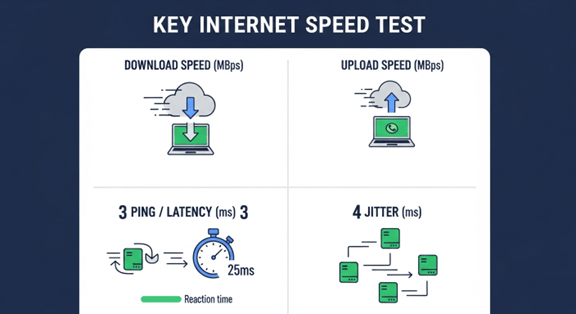
A breakdown of the key metrics in an internet speed test: Download, Upload, Ping (Latency), and Jitter.
The numbers generated by an internet speed test might seem daunting at first, but they tell a vital story about your connection's health and capabilities. Understanding these key metrics is the first step towards diagnosing and improving your online experience.
Download speed (Mbps): The gateway to content
This is arguably the most talked-about metric. Download speed, measured in megabits per second (Mbps), dictates how quickly your device can receive data from the internet. Think of it as the width of the highway carrying content to you. Faster download speeds mean quicker loading times for websites, seamless streaming of your favorite shows and movies in high definition, and faster downloads of files and applications. If you're experiencing slow browsing or constant buffering during video playback, your download speed is likely the culprit.
Upload speed (Mbps): Sharing your world
While often lower than download speeds, upload speed (also measured in Mbps) is just as critical for many online activities. This metric defines how quickly your device can send data to the internet. For Filipinos who increasingly rely on video calls for work and staying connected with family abroad, robust upload speeds are paramount. It impacts the quality of your outgoing video feed, how quickly you can upload photos and videos to social media or cloud storage, and the responsiveness of live-streaming. A weak upload speed can lead to choppy video calls and frustratingly slow file uploads.
Ping (latency in ms): The responsiveness of your connection
Ping, often referred to as latency, is measured in milliseconds (ms) and represents the time it takes for a small packet of data to travel from your device to a server and back. It's essentially the delay or "lag" in your internet connection. A low ping means your connection is highly responsive — and optimizing your DNS can help reduce it further — which is crucial for activities requiring real-time interaction, such as online gaming, video conferencing, and making VoIP calls. High ping, on the other hand, translates to noticeable delays – you click a button in a game, and it takes a moment for your character to react, or your voice in a call is heard a second after you speak.
Jitter (ms): The consistency of your connection
Closely related to ping, jitter measures the variation in latency over time. If your ping is like the speed of traffic on a road, jitter is how inconsistent that speed is. High jitter means the delays are erratic – sometimes quick, sometimes slow, causing an unpredictable connection. This inconsistency can be particularly disruptive for real-time applications. For instance, in a video call, high jitter can cause audio to drop out or become garbled, and video to stutter and freeze unpredictably, even if the average ping is acceptable.
Bandwidth: Your internet's capacity
While speed measures how fast data travels, bandwidth refers to the maximum amount of data that can be transmitted over your internet connection at any given time. Think of it as the total number of lanes on the highway. Your contracted internet plan specifies your bandwidth. If your bandwidth is limited, multiple devices or demanding applications running simultaneously can quickly saturate it, leading to slower speeds for everyone and everything connected. It's the overall capacity that enables your download and upload speeds.
Preparing for an accurate internet speed test
To get truly meaningful results from your internet speed test, preparation is key. A few simple steps can eliminate variables and ensure you're measuring your actual internet performance, not just the result of network congestion within your home or device limitations.
Use an Ethernet cable whenever possible
While Wi-Fi is convenient, it's susceptible to interference from other devices, physical obstructions, and distance from the router. For the most accurate and reliable speed test results, connect your computer directly to your router using an Ethernet cable. This provides a stable, direct connection, bypassing potential Wi-Fi bottlenecks and giving you a clearer picture of the speed coming into your home.
Minimize connected devices and background activity
Every device connected to your network consumes bandwidth. Before running a speed test, disconnect or pause usage on other devices, such as smartphones, tablets, smart TVs, and other computers. Also, close any unnecessary applications or browser tabs on the device you're using for the test, especially those that might be downloading or uploading data in the background (e.g., cloud syncing services, software updates, streaming apps).
Power cycle your router and modem
A simple reboot can often resolve temporary network glitches that might be affecting your speed. Unplug both your modem and router from the power source, wait for about 30-60 seconds, and then plug them back in, starting with the modem first. Allow both devices to fully boot up (usually indicated by steady lights) before proceeding with your speed test. This "power cycle" refreshes their connection to your Internet Service Provider (ISP).
Test at different times of day
Internet speeds can fluctuate significantly depending on network traffic. Peak hours, typically in the evening when most people are online, often see slower speeds due to increased demand on the ISP's network. To get a comprehensive understanding of your internet's performance, conduct your speed tests at various times – morning, afternoon, and late evening. This will reveal how your connection performs under different load conditions.
Ensure your device is optimized
Your device itself can sometimes be the bottleneck. Make sure your computer or mobile device has sufficient processing power and memory to handle the speed test. Ensure your operating system and network drivers are up to date. For a computer, using a modern web browser and disabling any VPNs or proxy servers during the test is also recommended for the most accurate results.
Step-by-step: How to perform an internet speed test
With your preparation complete, you're ready to run a speed test. The process is straightforward, but choosing the right tool and understanding the output is crucial.
Choosing a reliable speed test tool
Several reputable online tools can accurately measure your internet speed. Our built-in speed test tool right here on this page is designed specifically for users in the Philippines, connecting to local servers to ensure you get the most precise results for your area. It provides a detailed breakdown of your download speed, upload speed, and ping — all the metrics you need. For the most consistent comparison, try running the test multiple times at different hours of the day.
Running the test
Once you've chosen your preferred speed test tool:
Navigate to the website of your chosen speed test provider.
Select a server. Most tools automatically select the best server based on your location. However, if you're testing for a specific ISP like PLDT, Globe, or Converge, you might want to manually select a server geographically close to their major network hubs or one that the ISP recommends.
Click the "Go," "Start," or "Run Test" button. The test will then proceed, measuring your download speed, upload speed, and ping.
Wait for the results. This typically takes between 30 seconds to a minute.
Interpreting your initial results
After the test concludes, you'll see your download speed, upload speed, and ping (latency). Compare these numbers to your ISP plan's advertised speeds. Remember that advertised speeds are often "up to" figures, and real-world performance can be slightly lower, especially on Wi-Fi. A general rule of thumb is that you should be getting at least 80-90% of your advertised download speed when connected via Ethernet during off-peak hours. The ping should ideally be below 50ms for most general internet use, and certainly below 100ms. For competitive online gaming, many gamers aim for ping below 30ms.
ISP-specific speed test considerations (PLDT, Globe, Converge)
While the mechanics of running a speed test are universal, understanding your specific Internet Service Provider (ISP) can offer valuable context and help you interpret your results more effectively.
Checking your PLDT internet speed
PLDT, as a dominant player in the Philippine internet market, offers a wide range of fiber and DSL plans. When testing your PLDT internet speed, it's often beneficial to use their official speed test tool if available, as it's designed to connect to their network infrastructure. When using our speed test tool above, the system automatically selects the optimal server closest to your location. Pay attention to the speeds advertised on your specific PLDT plan – whether it's a fiber-to-the-home (FTTH) plan or an older DSL connection, as expectations for each will differ significantly. Fiber connections should consistently deliver speeds close to their advertised rates, while DSL speeds are more variable.
Checking your Globe internet speed
Globe also provides a comprehensive suite of internet services, including fiber and mobile broadband. For testing your Globe internet speed, similar to PLDT, utilizing Globe's own speed test utility can offer a direct line to their network performance metrics. When using external sites, choose servers that are geographically aligned with Globe's network presence. Understand the type of service you have – fiber optic, LTE, or 5G – as this heavily influences expected performance. If you're on a fiber plan, expect speeds much closer to your subscribed rate. For mobile broadband, speeds are inherently more variable due to signal strength and network congestion.
Checking your Converge ICT internet speed
Converge ICT has rapidly expanded its fiber-optic network across the Philippines, often positioning itself as a provider of high-speed, affordable fiber internet. When testing your Converge ICT internet speed, using their official speed test tool is a good starting point. Use our speed test tool to quickly check whether your actual speeds match what you're paying for. Converge's primary offering is fiber, which means users should generally expect speeds that closely match their advertised plans. If your results are consistently far below what you're subscribed to on a Converge fiber plan, it's a strong indicator that there might be an issue to investigate further.
Why speed test results may vary across platforms and ISPs
It's important to understand that your internet speed test results can vary for several reasons. The server you connect to plays a crucial role; a server that is overloaded or far away will yield different results than a nearby, lightly loaded one. Different testing platforms may use slightly different methodologies, leading to minor discrepancies. Furthermore, each ISP has its own network architecture, peering agreements, and traffic management policies. This means a test performed on PLDT's network might show different characteristics than one on Globe's or Converge's, even if both users have plans with similar advertised speeds. Your home network configuration, including your router's capabilities and Wi-Fi signal strength, also profoundly affects the data you receive.
What's a "good" internet speed for your needs?
The question of what constitutes a "good" internet speed is highly personal and depends entirely on your online activities. There's no single answer, but understanding your typical usage can help you set realistic expectations.
Aligning speed with your online activities
Basic Browsing and Email: For simple web surfing, checking emails, and occasional social media use, download speeds as low as 5-10 Mbps are generally sufficient.
Streaming HD Video:To enjoy movies and TV shows on platforms like Netflix or YouTube in high definition without buffering, you'll typically need download speeds of at least 15-25 Mbps per stream. For 4K streaming, this requirement jumps to 25-50 Mbps or more.
Online Gaming: While download and upload speeds are important, a low ping (latency) is paramount for a smooth gaming experience. For most online games, aiming for ping below 50ms is ideal, with competitive gamers often seeking speeds under 30ms. Upload speeds of 5-10 Mbps are usually adequate.
Video Conferencing and Work from Home: For clear video calls, both good download and upload speeds are necessary. A reliable connection with at least 10-15 Mbps download and 5-10 Mbps upload is a good starting point for regular video conferencing.
Large File Downloads/Uploads: If you frequently download or upload large files, higher download and upload speeds will significantly reduce waiting times.
Comparing your results to your PLDT/Globe/Converge plan
Once you have your speed test results, compare them against the bandwidth and speed advertised in your PLDT, Globe, or Convergeplan. Remember that advertised speeds are often "up to" maximums. If you're consistently getting less than 80% of your advertised download speed on a wired connection during off-peak hours, it might be worth investigating further. Similarly, if your ping is consistently high and impacting your activities, this is a key piece of data to discuss with your ISP.
Troubleshooting slow internet speeds
Encountering slow internet performance can be incredibly frustrating, but many common issues can be resolved with simple troubleshooting steps.
Quick fixes you can try yourself
Reboot Your Equipment: As mentioned, power cycling your modem and router is the first, most effective step.
Check Your Wi-Fi Signal: If you're using Wi-Fi, ensure you're close to your router and that there are no major obstructions (like thick walls or large appliances) interfering with the signal. Consider repositioning your router to a more central location in your home.
Limit Simultaneous Users: If multiple people or devices are heavily using the internet at the same time, speeds will naturally divide. Try to consolidate usage if possible.
Scan for Malware: Malware on your computer can consume bandwidth and slow down your connection. Run a reputable antivirus scan.
Test with Different Devices and Browsers: Ensure the issue isn't specific to one device or browser. Test your internet speed on another computer or your smartphone.
Conclusion: Take control of your internet experience
Navigating the world of internet speeds can feel complex, but by understanding the key metrics and employing straightforward testing methodologies, you can gain invaluable insights into your home network's performance. Your internet speed test is more than just a number; it's a crucial piece of data that empowers you to understand your connection, diagnose issues, and ensure you're receiving the service you pay for from providers like PLDT, Globe, and Converge.
We've explored how download speeds and upload speeds impact your daily online activities, how ping and jitter affect responsiveness, and the role of bandwidth as your internet connection's capacity. By preparing adequately for your test– using an Ethernet cable, minimizing device load, and power cycling your router – you ensure the most accurate results. Remember that your internet speed can vary, so testing at different times and understanding ISP-specific considerations is key.
What constitutes a "good" speed is relative to your needs, whether it's streaming, gaming, or working. Armed with your results, you can now compare them against your plan and begin troubleshooting. Simple steps like rebooting your equipment or optimizing your Wi-Fi can make a significant difference.
Don't let a sluggish internet connection hold you back. This guide is your first step towards becoming a more informed and empowered internet user in the Philippines. Take control, run your tests, understand your data, and advocate for the reliable, fast internet you deserve. Your digital life is waiting.