Are you tired of the agonizing crawl of slow internet speeds? Does buffering feel like a constant companion during your streaming sessions, or do web pages take an eternity to materialize? You're not alone. In our hyper-connected world, a sluggish internet connection is more than just an annoyance; it's a productivity killer and a source of endless frustration. Many users accept their internet speed as is, believing it's beyond their control. But what if I told you there's a powerful, yet often overlooked, key to unlocking a dramatically faster, more secure, and private online experience? That key lies within your DNS settings.
This isn't just about tweaking a few numbers; it's about taking control of your digital life. We're about to embark on a journey to understand the unseen engine of the internet – the Domain Name System (DNS) – and discover how optimizing it can transform your daily online interactions. Get ready to say goodbye to frustrating delays and hello to a lightning-fast, resilient internet connection.
Unlock faster internet: What is DNS and why change it?
Imagine the internet as a colossal, sprawling city. To navigate this city, you need addresses. While we humans prefer friendly street names like google.com, computers speak a different language: a series of numbers called IP addresses. This is where the magic of DNS comes in.
What exactly is DNS? The internet's phonebook
At its core, the Domain Name System, or DNS, acts as the internet's indispensable phonebook. When you type a website address into your browseror click a link, your device doesn't inherently know where to find that website. It needs to translate the human-readable domain name into a machine-readable IP address. This translation process is handled by DNS servers. Your computer queries a DNS server, which looks up the corresponding IP address and sends it back. This entire lookup process, often happening in milliseconds, is fundamental to every single connectionyou make online. In 2023, Vercara's UltraDNS platform alone processed an astounding 41.97 trillion DNS queries, with a daily average of 115.01 billion queries, a testament to the sheer volume and critical nature of DNS operations.
Your internet service provider's (ISP) default DNS
For most of us, our Internet Service Provider (ISP) automatically assigns us their default DNS server. This is the simplest setup – plug in your router, connect your devices, and you're online. However, these ISP-provided DNS servers are often generic. They might be geographically distant, overloaded with traffic, or not optimized for the best performance or security. This can lead to slower lookup times, as your query has to travel further or wait in a longer queue. Furthermore, your ISP can see every domain you look up, creating potential privacy concerns.
The impact of DNS on your internet experience
The quality of your DNS serverhas a profound and direct impact on your entire online experience. The time it takes for a DNS lookup can be the difference between a website loading instantly or feeling sluggish. This isn't just about web pages; it affects app updates, online gaming, streaming services, and even the responsiveness of your overall network. DNS resolution typically takes between 20-120 milliseconds per lookup, and cumulative effects across multiple resources can create noticeable delays in website loading. When you consider how many DNS lookups happen just to load a single webpage, these small delays add up, creating the frustrating lag that so many experience.
The tangible benefits: Why optimizing DNS matters
Understanding that DNS is the internet's phonebook is one thing, but seeing the tangible benefits of optimizing it is what truly ignites the desire for change. This isn't just a theoretical technical improvement; it translates into a demonstrably better online life.
Experience noticeable speed improvements
The most immediate and widely appreciated benefit of switching to a faster, more efficient DNS service is increased speed. When your DNS queries are resolved quicker, your browsercan fetch website data faster, leading to significantly reduced page load times. Imagine websites snapping into view instead of making you wait, or videos starting to play without that initial buffering pause. While individual DNS lookups might seem trivial, the cumulative effect is substantial. This isn't an exaggeration; a 1-second delay in web page load time can reduce customer satisfaction by 16%. For remote workers, the impact is even more pronounced: a 2023 Statista study found that 73% of remote workers reported slow internet speeds reduced their productivity by at least 20%. Optimizing your DNS is a powerful, accessible way to reclaim lost productivity and enjoy a smoother, more responsive internet.
Boost your online security and protection
Beyond sheer speed, changing your DNS settings is a proactive step towards bolstering your online security. Many third-party DNS providers offer built-in security features that can block access to known malicious websites, phishing attempts, and malware-hosting domains. These services act as a crucial first line of defense, filtering out dangerous content before it even reaches your device. By choosing a reputable DNS server with strong security protocols, you can significantly reduce your exposure to common online threats, providing a vital layer of protection for your network and all connected devices.
Enhance your digital privacy
In an era where data is a precious commodity, protecting your online privacyis paramount. When you use your ISP's default DNS, they can log your browsing activity. This data can be used for various purposes, from targeted advertising to being sold to third parties. By switching to a third-party DNS provider with a strong privacy policy, you can often prevent your ISP from tracking your every online move. Many modern DNS services also support encrypted DNS protocols like DNS-over-HTTPS (DoH) and DNS-over-TLS (DoT), which encrypt your DNS queries, making them unreadable to anyone intercepting them, including your ISP. This significantly enhances your anonymity and protects your browsing habits from prying eyes.
Other potential advantages: Content filtering and more
The benefits of optimized DNS extend even further. Many DNS services offer features like content filtering, which can be invaluable for parental controls, allowing you to block adult content or other undesirable websites for younger users. Some services can also help bypass geo-restrictions or censorship in certain regions, though this often depends on the specific DNS provider and the method used. By taking control of your DNS, you gain more granular control over your internet experience, tailoring it to your specific needs for safety, productivity, and access.
Choosing your ideal DNS server: A smart selection guide
With the compelling reasons to switch now clear, the next logical step is selecting the right DNS service to power your online world. The market offers a variety of excellent public DNS servers, each with its own strengths. Making an informed choice ensures you reap the maximum benefits.
Top public DNS servers for speed, security, and privacy
Several prominent DNS providers have emerged as leaders, offering a compelling blend of performance, security, and privacy.
Google Public DNS (8.8.8.8 and 8.8.4.4): One of the most popular choices, Google Public DNS is renowned for its speed, reliability, and extensive global infrastructure. It's a solid all-around option for most users seeking a performance boost.
Cloudflare DNS (1.1.1.1 and 1.0.0.1): Cloudflare has rapidly gained traction with its strong emphasis on privacy and impressive speed. They are committed to not logging personally identifiable DNS data and offer robust security features. Many users report near-instantaneous lookup times with Cloudflare.
Quad9 (9.9.9.9 and 149.112.112.112): Quad9 distinguishes itself with a primary focus on security. It blocks access to known malicious domains based on threat intelligence feeds from multiple organizations, providing an excellent layer of protection against malware and phishing without significantly impacting speed.
OpenDNS: While perhaps not as cutting-edge in raw speed as Cloudflare or as universally adopted as Google Public DNS, OpenDNS has a long-standing reputation for providing reliable DNS services with customizable filtering options, making it a good choice for families or small businesses.
Public DNS resolvers account for nearly 60% of recursive DNS usage, with Google leading at over 30% (based on 2023 data). This widespread adoption underscores the trust and effectiveness of these public alternatives.
Key factors to consider when making your choice
When selecting a DNS server, consider these critical factors:
Speed (Latency): How quickly does the server respond to your requests? Lower latency means faster lookups and a snappier internet experience. Many services offer tools to test this.
Reliability and Uptime: Your internet is only as reliable as your DNS. Choose providers with a proven track record of high uptime.
Security Features: Does the provider offer built-in protection against malicious sites? Do they support encrypted DNS protocols like DoH and DoT?
Privacy Policy: Thoroughly review the DNS service's privacy policy. What data do they collect? How is it used? Do they sell data? Prioritize providers with clear, user-friendly privacy commitments.
Location of Servers: While less critical with global networks, sometimes choosing a DNS provider with servers closer to your geographical location can offer marginal speed benefits.
Tools to test and compare DNS performance
To make a truly data-driven decision, you can use various tools to test DNS performance. While simple ping tests can give a basic idea, dedicated DNS benchmarking tools can provide more comprehensive results. Some software can test the lookup speed of numerous DNS servers from your location, helping you identify the fastest option for your specific network connection. Exploring these tools can demystify the process and empower you to choose the optimal DNS address for your needs.
Step-by-step: Changing DNS settings on your devices
The prospect of changing DNS settingsmight seem daunting, but it's surprisingly straightforward across most devices. The general principle involves inputting the DNS server addresses into your device's network settings . You'll typically need to enter a primary and a secondary DNS server. The secondary serves as a backup if the primary becomes unavailable, ensuring uninterrupted connection.
General principles: Primary DNS and secondary DNS
When you configure your DNS settings, you'll usually have fields for both "Preferred DNS server" (Primary DNS) and "Alternate DNS server" (Secondary DNS). It's vital to populate both fields to ensure redundancy. For instance, if you choose Google Public DNS, you'd enter 8.8.8.8 as the primary and 8.8.4.4 as the secondary. If you opt for Cloudflare, it would be 1.1.1.1 and 1.0.0.1. Using these DNS server addresses ensures that your device knows where to turn for swift and reliable domain name translations.
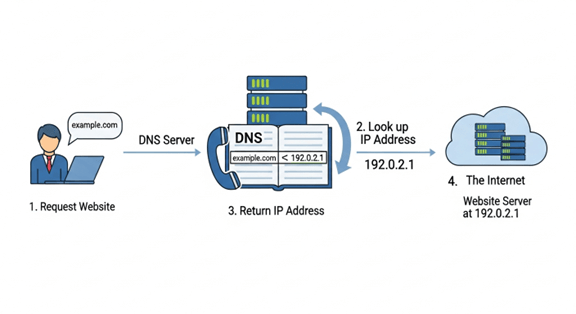
The DNS process translates a human-readable domain name into a machine-readable IP address, allowing your browser to connect to the correct website.
Changing DNS on Windows PC
Open Network Connections: Search for "View network connections" in the Windows search bar and open it.
Select Your Adapter: Right-click on your active network adapter (e.g., "Wi-Fi" or "Ethernet") and select "Properties."
Access Internet Protocol Properties: In the properties window, find and select "Internet Protocol Version 4 (TCP/IPv4)" and click "Properties."
Enter DNS Addresses: Choose "Use the following DNS server addresses." Enter your preferred primary and secondary DNS server addresses in the respective fields. If you wish to configure IPv6, select "Internet Protocol Version 6 (TCP/IPv6)" and enter the corresponding IPv6 addresses provided by your chosen DNS service.
Apply Changes: Click "OK" on all open windows to save your new DNS settings.
Changing DNS on macOS
Open System Preferences: Click the Apple menu and select "System Preferences."
Navigate to Network: Click on the "Network" icon.
Select Your Connection: Choose your active network connection (e.g., Wi-Fi or Ethernet) from the left-hand panel.
Access Advanced Settings: Click the "Advanced..." button.
Enter DNS Addresses: Go to the "DNS" tab. Click the "+" button under the DNS Servers list to add your primary and secondary DNS server addresses. For IPv6, ensure your chosen provider offers IPv6 addresses and add them similarly.
Confirm and Apply: Click "OK," then click "Apply" in the main Network window to save your changes.
Changing DNS on Android devices
The exact steps can vary slightly depending on your Android version and manufacturer, but the general path is:
Open Wi-Fi Settings: Go to "Settings" > "Network & internet" > "Wi-Fi."
Modify Network: Tap and hold the Wi-Fi network you are connected to, then select "Modify network" or tap the gear icon next to it.
Advanced Options: Look for an "Advanced options" or similar setting.
Change IP Settings: Find the "IP settings" and change it from "DHCP" to "Static."
Enter DNS Addresses: You will now see fields for your IP address, Gateway, and DNS 1 and DNS 2. Enter the primary and secondary DNS server addresses here. You may also need to configure IPv6 addresses if your network supports them.
Save: Tap "Save."
Changing DNS on iOS devices
Open Wi-Fi Settings: Go to "Settings" > "Wi-Fi."
Select Your Network: Tap the "i" icon next to the Wi-Fi network you are connected to.
Configure DNS: Scroll down to the "DNS" section and tap "Configure DNS."
Choose Manual: Select "Manual."
Enter DNS Addresses: Delete any existing entries and tap "Add Server" to input your primary and secondary DNS server addresses. iOS generally handles IPv6 automatically if the network provides it and the DNS server supports it, but specific IPv6 addresses can be added here if needed.
Save: Tap "Save" in the top right corner.
Changing DNS on Linux and ChromeOS (brief overview)
For Linux users, DNS settings are typically managed through the network settings panel of your desktop environment (e.g., GNOME, KDE). You'll generally find options to manually set DNS server addresses within the network connection properties. ChromeOS users can also configure DNS through their network settings, often by accessing advanced Wi-Fi options and manually inputting the desired DNS address for a specific connection.
Network-wide optimization: Changing DNS on your router
While changing DNS on individual devices is effective, there's an even more comprehensive and convenient way to ensure all your devices benefit from faster, more secure, and private internet: configuring your router.
The advantages of router-level DNS changes
When you change the DNS settings on your router, every device that connects to your Wi-Fi or wired network automatically inherits those settings. This means your smartphones, smart TVs, gaming consoles, laptops, and any other internet-connected device will use your chosen, optimized DNS server. It's a set-it-and-forget-it solution that ensures consistent performance and protection across your entire home network, eliminating the need to configure each device individually. This is particularly advantageous for devices that don't easily allow manual DNS configuration.
General steps to configure DNS on your wireless router
The process for changing DNS on a router involves accessing its administrative interface.
Find Your Router's IP Address: This is typically 192.168.1.1 or 192.168.0.1. You can usually find it printed on a sticker on the router itself or by checking your computer's network settings.
Access the Admin Interface: Open a web browserand type your router's IP address into the address bar.
Log In: You'll be prompted for a username and password. If you haven't changed them, these are often default credentials (e.g., "admin/admin" or "admin/password") found in your router's manual or on the device.
Locate DNS Settings: Navigate through the router's menus. Look for sections like "WAN," "Internet," "Network Settings," or "DHCP Server." Within these, you should find fields for DNS servers.
Enter DNS Server Addresses: Input your chosen primary and secondary DNS server addresses. Ensure you enter the correct IP addresses for both.
Save and Restart: Apply your changes and, importantly, restart your router to ensure the new settings are fully implemented.
Router-specific considerations
Every routermanufacturer and model has a slightly different interface. Some routers might have dedicated fields for DNS settings, while others might embed them within DHCP or WAN configuration menus. If you're struggling to find the settings, consult your router's user manual or the manufacturer's website for specific instructions. For example, Google Nest Wifi and Google Wifi devices automatically offer DNS query handling, allowing you to set new DNS server addresses.
Verifying your changes and troubleshooting common issues
Implementing new DNS settingsis only part of the process. It's crucial to verify that your changes are active and to know how to address any potential issues that might arise.
Confirming your new DNS settings are active
After changing your DNS settings on a device or your router, you need to confirm they're working. The simplest way is to use an online DNS checker tool. These tools allow you to enter a domain name and see which DNS server is resolving it for your connection. If the tool shows the DNS server addressesyou just entered, congratulations – your new settings are active!
Flushing your DNS cache for immediate effect
Sometimes, your operating system or browsermight still be using old DNS information stored in its cache. This "DNS cache" helps speed up future lookups but can interfere with immediate changes. To ensure your new settings take effect instantly, you'll need to flush your DNS cache.
On Windows: Open Command Prompt as an administrator and type
ipconfig /flushdnsthen press Enter.On macOS: Open Terminal and type
sudo dscacheutil -flushcache; sudo killall -HUP mDNSResponderand press Enter. You'll need to enter your administrator password.On Android/iOS: Often, a device restart or toggling your Wi-Fi off and on can effectively clear the cache.
A quick restart of your device or router after making changes can also help ensure all components are using the updated DNS settings.
Troubleshooting common problems
If you encounter issues after changing your DNS settings, don't panic. Common problems include:
Slowdowns: If you experience slower speeds, the DNS service you chose might be performing poorly for your network or location. Try switching to another reputable provider.
Inability to Access Certain Sites: Some niche websites or services might have issues with specific DNS providers.
General Connectivity Issues: If you lose internet connectionaltogether, the most straightforward troubleshooting step is to revert to your ISP's default DNS servers. If connection is restored, the issue lies with your chosen third-party DNS.
Always remember the DNS server addressesof your ISP or a well-known public DNS like Google's, so you can quickly revert if needed. A simple device restart can also resolve many transient issues.
Advanced DNS concepts: A glimpse into the future
As we continue to push the boundaries of online interaction, DNS technology is evolving rapidly. Two key advancements, DNS-over-HTTPS (DoH) and DNS-over-TLS (DoT), are revolutionizing privacy and security.
Deep dive into DNS-over-HTTPS (DoH) and DNS-over-TLS (DoT)
Traditional DNS queries are sent in plain text, making them vulnerable to eavesdropping and manipulation. DoH and DoT encrypt these queries, effectively tunneling them through HTTPS or TLS protocols. This means your ISP or anyone monitoring your network cannot see which websites you are requesting. This is a monumental leap for privacy, preventing your browsing history from being easily logged or sold. Cloud-based DNS solutions accounted for over 60% of new installations in 2024 for Private DNS over HTTPS for Mobile, driven by scalability, flexibility, and cost-effectiveness. Many modern DNS providers, including Google and Cloudflare, support these protocols. Configuring them often involves deeper network settings on your operating system or browser, but the added layer of security and privacy is a compelling reason to explore them. These technologies are paving the way for a more secure and private internet experience, especially crucial as IPv6 addresses become more prevalent and the volume of online activity continues to grow.
Conclusion
The internet is an incredible tool, and its performance is directly influenced by its foundational components, including DNS. We've journeyed from understanding the fundamental role of DNS as the internet's phonebook to exploring the tangible benefits of optimizing it: a significant boost in speed, enhanced security, and increased privacy. By choosing reputable DNS servers like Google Public DNS, Cloudflare, or Quad9, and implementing these changes either on your individual devices or, for ultimate convenience, on your router, you are actively taking control of your online experience. The global DNS services market was valued at $5.97 billion in 2024 and is projected to reach $27.14 billion by 2033, highlighting the immense and growing importance of these services. Don't let a slow or insecure connection hold you back any longer. Embrace the power of optimized DNS and unlock a faster, safer, and more private internet today. It's time to master your connection.